
I wanted to ramble a bit about how I think of kitchen knife design. This is not a hard and fast mathematical process, just generally how I approach things. I’m trying to describe the shapes I’m conceptualising as I’m forging here.
The basic shape of the blade is a triangle, the handle is attached at one corner of the base, the long side away from that is the edge.
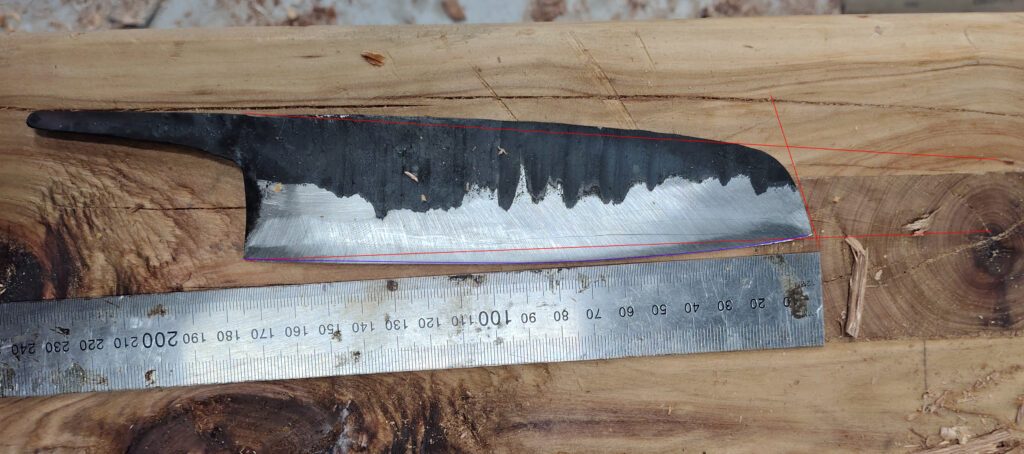
The first question is how high I want the point. If the point is high up on the blade, in line with the handle, then the triangle is closer to a right angle. As the point moves down the triangle moves through being an isosceles and back towards a right angle. The length of the triangle determines how parallel the spine and edge are.
In my opinion, a lower point is better for knives that are being used in a large slicing motion. It’ll be easier to drag the point along a chopping board. A higher point is better for focused poking, like cutting out an eye in a potato.
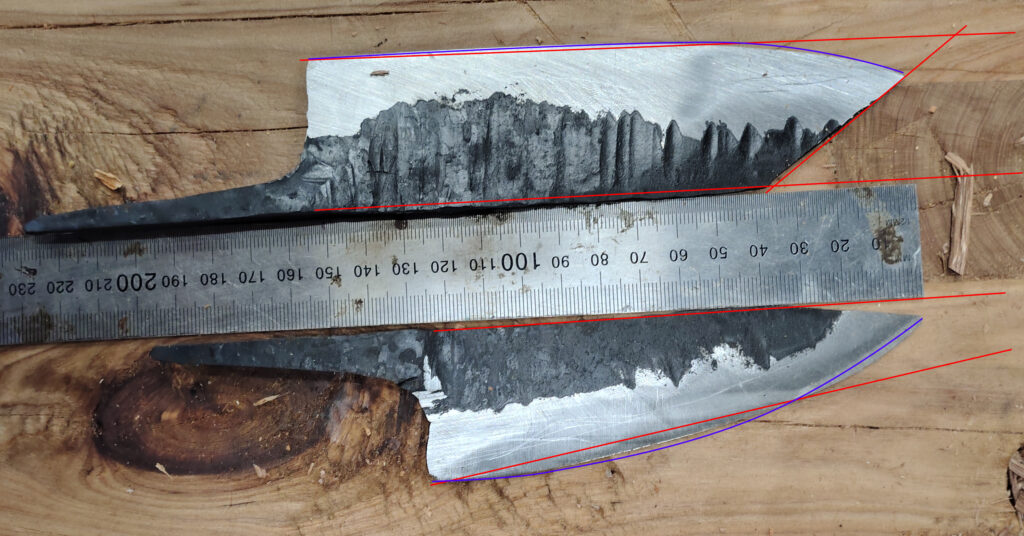
This triangle may be too long for the intended knife. For some long thin slicing knives the triangle can be close to the final shape, but for smaller ones like those pictured here the triangle will often need to be cut off. This line can form the K-tip, or describe the two lines that a curved spine will join
Next step is to add some curve to the cutting edge. Without some curve the blade will almost immediately develop a hollow when being sharpened. It’s also necessary to have a knife that is comfortable to use, as human hands don’t move in straight lines. Knives for rock chopping need more curve, knives for pull slicing need less, and you may want a knife to be fairly straight for most of the length and then curve at the end to move the tip up.
The shape of the tang is quite simple, but still important. It should be a square based pyramid, tapering both horizontally and vertically. Having it come to a point isn’t necessary, but you can see from the above photos that it should get close. This concentrates the mass where it’s needed for strength and uses the material efficiently.
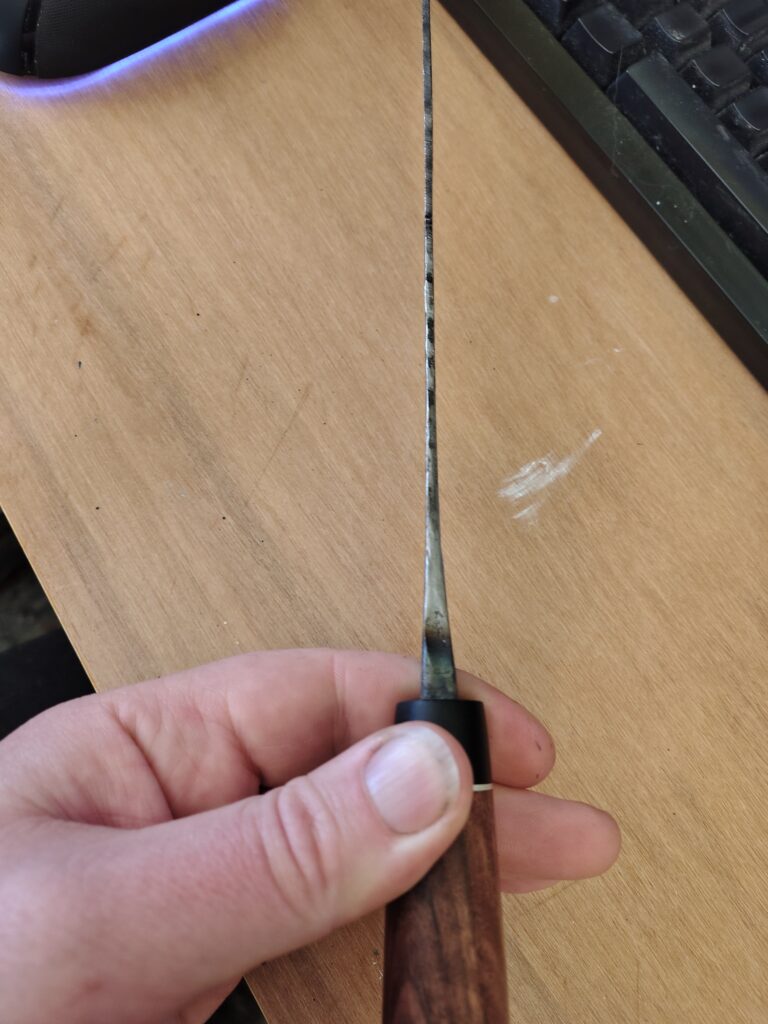
Final question is blade thickness. I like the area where the tang transitions into the blade to be thicker: this is a high stress area so the extra material makes it stronger, and this is also about where i want the centre of mass. Mine are usually about 5-8mm at this point. The actual blade needs to be a lot thinner than this, if it’s too thick it’ll wedge things apart, so there needs to be a quick reduction down to around 3mm.
Making the blade too thin makes it too flexible, something I don’t like, so I’ll go down to about 2mm at the tip, trying to get an even taper from the 3mm past the tang.
Shaping the blade like this does give a slightly heavier knife than just making it out of 3mm stock. Mine tend to be 200 to 250g, but it also gives really good centre of mass, which I think is as important as the weight.
Leave a Reply